In popular media, poker is frequently portrayed as a game of psychological warfare, intuition, and dramatic bluffs. While reading opponents and managing table dynamics certainly play a role, sustained profitability in poker relies on a concrete foundation of mathematics and decision theory. The most successful poker players in the world do not make choices based on gut instinct; they make decisions based on mathematical edges.
Two central concepts form the backbone of sound strategic play: pot odds and expected value. Understanding how these two principles operate and interact transforms poker from an emotional guessing game into a discipline of risk management and calculated probability. Mastering these formulas allows you to determine whether calling a bet is profitable over the long term, regardless of the outcome on any single hand.
The Core Concept of Expected Value
Expected value, commonly abbreviated as EV, is a statistical metric used to determine the average financial outcome of a specific decision if that exact scenario were repeated hundreds or thousands of times.
In poker, every possible action—folding, calling, betting, or raising—carries an associated expected value. These values fall into two distinct classifications:
-
Positive Expected Value (+EV): A play that will generate a net profit over a large sample of hands. Even if you lose money on a single trial due to bad luck, executing a positive expected value action remains correct because it will yield positive returns over time.
-
Negative Expected Value (-EV): A play that will result in a net financial loss over time. Even if an unfavorable play occasionally wins due to random variance, continuing to make negative expected value moves guarantees an erosion of your bankroll.
The fundamental formula for calculating expected value is straightforward:
Expected Value equals the probability of winning multiplied by the amount won, minus the probability of losing multiplied by the amount lost.
When the resulting number is greater than zero, the action is profitable. When it is less than zero, the action loses money.
Understanding Pot Odds
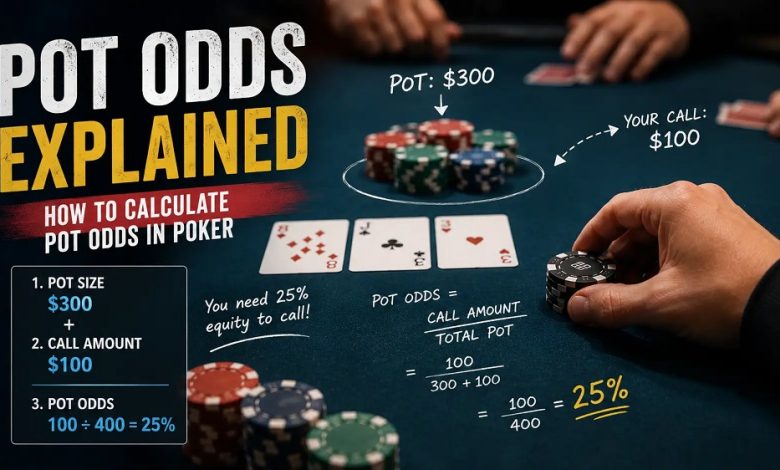
Pot odds represent the direct mathematical relationship between the current size of the pot and the cost of the call facing you. It is the financial price the game offers you to continue playing a hand.
To calculate pot odds, you compare the amount of money you must call against the total pot size after the opponent bet is included. Pot odds can be expressed as a traditional ratio or as a straightforward percentage.
Expressing Pot Odds as a Ratio
Assume the pot contains eighty dollars, and your opponent bets twenty dollars. The total pot is now one hundred dollars. To stay in the hand, you must call twenty dollars.
-
Pot-to-Call Ratio: One hundred dollars to twenty dollars.
-
Simplified Ratio: Five to one.
This ratio means you are risking one unit of currency to win five units from the pot.
Expressing Pot Odds as a Percentage
Converting pot odds into a percentage makes it simple to compare against your actual chance of winning the hand.
The formula to calculate pot odds as a percentage is:
Call amount divided by the total pot after your call, multiplied by one hundred.
Using the previous example:
-
You must call twenty dollars.
-
The total pot after your call will be eighty plus twenty plus twenty, which equals one hundred twenty dollars.
-
Twenty divided by one hundred twenty equals zero point one six six, or roughly sixteen point seven percent.
This percentage indicates that for your call to break even in the long run, your hand must win at least sixteen point seven percent of the time.
Calculating Your Hand Equity: Outs and the Rule of Two and Four
Once you know your pot odds percentage, the next step is determining your equity—the actual probability that your drawing hand will improve to become the winning hand.
To find your equity, you first count your “outs.” An out is any unseen card remaining in the deck that will complete your desired hand combination.
Common Out Counts in Texas Hold’em
-
Flush Draw: You hold two cards of one suit and the board contains two of that same suit. There are thirteen cards of each suit in a deck. Four are visible, leaving nine outs to complete the flush.
-
Open-Ended Straight Draw: You hold four consecutive cards (such as 8-9 on a board of 6-7-K). Any 5 or 10 will complete your straight. With four 5s and four 10s in the deck, you have eight outs.
-
Inside Straight Draw (Gutshot): You hold a broken sequence (such as 8-9 on a board of 6-J-K) needing a single specific rank (a 7) to complete the hand. There are four remaining 7s, giving you four outs.
-
Two Overcards: You hold Ace-King on a low board (such as 2-5-8) and believe pairing either card will win. There are three unseen Aces and three unseen Kings, giving you six outs.
The Rule of Two and Four
Calculating exact percentages during a live hand can be difficult. The Rule of Two and Four provides an accurate mental shortcut:
-
On the Flop (Two Cards to Come): Multiply your number of outs by four to approximate your percentage chance of hitting your hand by the river. If you have nine outs on the flop, your equity is roughly thirty-six percent (nine multiplied by four).
-
On the Turn (One Card to Come): Multiply your number of outs by two to approximate your percentage chance of completing your draw on the river. If you have nine outs on the turn, your equity is roughly eighteen percent (nine multiplied by two).
Merging Pot Odds and Equity to Make Decisions
The fundamental decision-making rule in poker draw situations comes down to a simple comparison:
-
If your hand equity is greater than your pot odds percentage, calling is Positive Expected Value (+EV).
-
If your hand equity is lower than your pot odds percentage, calling is Negative Expected Value (-EV).
Practical Scenario Walkthrough
Imagine you are on the turn holding a four-card flush draw (nine outs). There is seventy dollars in the pot, and your opponent bets thirty dollars.
-
Step 1: Calculate the Pot Odds. You must call thirty dollars to contest a total pot of one hundred thirty dollars (seventy plus thirty plus your thirty). Thirty divided by one hundred thirty equals twenty-three percent. You need twenty-three percent equity to justify calling.
-
Step 2: Calculate Your Equity. You have one card to come. Using the Rule of Two, nine outs multiplied by two equals eighteen percent equity.
-
Step 3: Compare. Your equity (eighteen percent) is lower than the price offered by the pot (twenty-three percent). Calling here is a negative expected value decision. Over time, making this call repeatedly will result in net losses. The correct mathematical play is to fold.
Expanding the Equation: Implied Odds and Reverse Implied Odds
Basic pot odds evaluate only the money currently sitting in the pot. However, poker involves multiple betting streets, meaning future action must often be factored into the decision.
Implied Odds
Implied odds represent the additional money you expect to win from your opponent on future streets if you hit your drawing card. If your basic pot odds are slightly insufficient to call, but you know your opponent is aggressive and will pay off a large bet on the river when you complete your draw, the call can become positive expected value.
To assess implied odds, consider:
-
Stack Depths: Both you and your opponent must have sufficient chips behind to make future betting meaningful.
-
Deception of the Draw: A disguised draw (such as an inside straight) has higher implied odds than an obvious flush draw, which opponents will recognize and fold against.
-
Opponent Tendencies: Loose, calling-station opponents offer much higher implied odds than disciplined, cautious players who easily let go of second-best hands.
Reverse Implied Odds
Reverse implied odds describe situations where hitting your draw does not guarantee winning the pot and may instead cost you significant additional chips.
For example, drawing to a low flush when an opponent might be drawing to a higher flush, or completing a straight on a paired board where an opponent might hold a full house, carries severe reverse implied odds. When reverse implied odds are high, you require even better immediate pot odds to justify continuing.
Embracing Long-Term Variance
A crucial psychological aspect of poker mathematics is understanding that probability does not guarantee short-term success. You can make a flawless positive expected value call with an eighty percent chance to win and still lose the hand twenty percent of the time.
This short-term fluctuation is known as variance. Disciplined players measure their success not by whether they won a specific pot, but by the mathematical quality of the choices they made throughout the session. If you consistently make positive expected value decisions and manage your bankroll prudently, mathematical probability ensures that variance will smooth out and profitability will follow.
Frequently Asked Questions
What is the difference between direct pot odds and implied odds?
Direct pot odds calculate the mathematical value of a call based entirely on the chips currently in the pot right now. Implied odds expand that calculation to account for chips you anticipate winning on subsequent betting rounds if your drawing hand hits.
Can pot odds be used when deciding whether to place a bet or bluff?
While pot odds are primarily used to evaluate facing a bet, the inverse math applies when betting. By calculating your bet size relative to the pot, you determine your bluffing break-even point—the percentage of times your opponent must fold for your bluff to generate immediate positive expected value.
Why do open-ended straight draws have fewer outs than flush draws?
An open-ended straight draw can be completed by two different card ranks (eight total cards), whereas a flush draw can be completed by any of the nine remaining cards of that specific suit. Therefore, flush draws possess nine outs (roughly eighteen percent on one street), while open-ended straight draws have eight outs (roughly sixteen percent on one street).
How does the rake charged by a poker room affect pot odds and expected value?
The rake is a small percentage taken by the cardroom from every cash pot. By removing money from the total pot, the rake slightly decreases the pot odds offered on calls and reduces the overall expected value of marginal decisions. In high-rake games, players must play tighter and avoid marginal, borderline calls.
What does it mean when a play is described as neutral expected value?
A neutral expected value play (zero EV) is a decision that yields neither an expected profit nor an expected loss over the long run. In theory, folding always has an expected value of exactly zero for the remainder of that hand because no further capital is risked or won.
How do blockers impact the calculation of outs and hand equity?
Blockers are cards in your hand or on the board that eliminate potential cards from your opponent’s range or remove your own outs. For example, if you hold the Ace of a suit, you know your opponent cannot possess the nut flush draw. Conversely, if your straight outs overlap with cards that would complete a potential flush for your opponent, those outs are tainted and should be discounted from your calculation.
Why should you avoid drawing to split-pot straights?
Drawing to a straight that utilizes four community cards on the board (known as an idiot-end straight or board-dependent straight) carries high risk for low reward. If you hit your card, you frequently share the pot with other players who hold the same rank, reducing your payoff while risking a full bet if an opponent holds a higher straight.